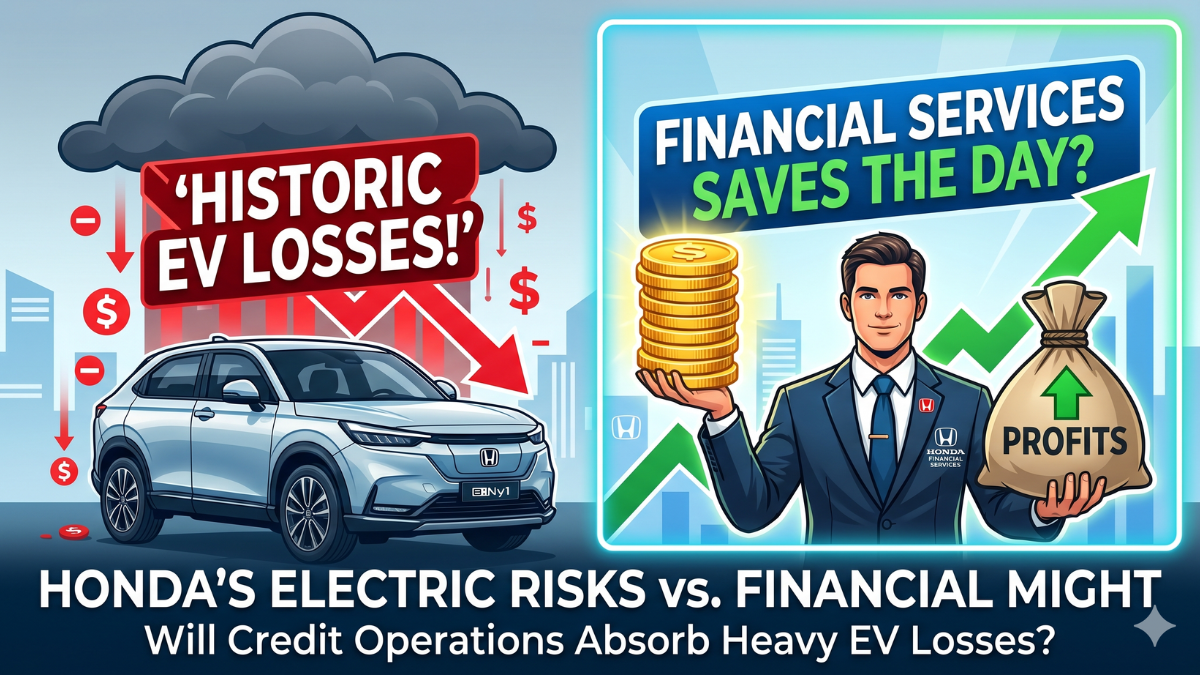
Honda is heading into its first annual loss in nearly 70 years as a listed company, absorbing up to $15.7 billion in restructuring costs tied to its EV business after canceling 3 models that had been planned for North American production. CNBC
The cause is blunt. In July 2025, the U.S. Senate passed legislation that abruptly reversed the federal EV tax credit, taking effect immediately. Ford and Stellantis booked their own hefty write-downs around the same period. The Cool Down
Against that backdrop, Honda’s financial services arm is being positioned as a stabilizer.
Honda’s CFO has explicitly flagged the financial services business as a source of “stable cash generation” as the company works through the transition, alongside growth from its motorcycle business and next-generation hybrids planned for 2027. Honda
That’s a real job. Honda now expects a net loss of between ¥420 billion and ¥690 billion for the fiscal year ending March 31, reversing a previously forecast ¥300 billion net profit. Someone has to keep the cash flowing while the automaker regroups, and Honda Financial Services is the answer. CBT News
The hybrid pivot is central to the plan. Honda built its Ohio production lines to shift quickly between gas, hybrid, and EV configurations depending on demand, and demand right now is clearly pointing toward hybrids. The Civic Hybrid launched in North America in September 2024, and the automobile business is expected to expand further with HEV models despite tariff impacts. Honda Financial Services’ low financing rates on those vehicles become a pull mechanism for the whole strategy. Yahoo FinanceHonda
Despite the scale of losses, Honda’s assistant VP of auto sales described the company as counting its successes, noting 3 vehicles in the lineup priced below the average used car: the HR-V, the Civic, and the Accord. Affordable cars financed through a captive lender is a formula Honda knows well. Yahoo Finance
Honda’s executives have gone as far as forfeiting their short-term performance compensation for the fiscal year ending March 31, 2026. That’s not theater. It signals the company is treating this as a genuine reset, not a one-quarter anomaly. Honda Global
The financial services business didn’t cause the EV write-down. But it has to help absorb the aftermath. Stable financing income while the auto business restructures is exactly the kind of unglamorous work that keeps a company like Honda intact through a rough transition.