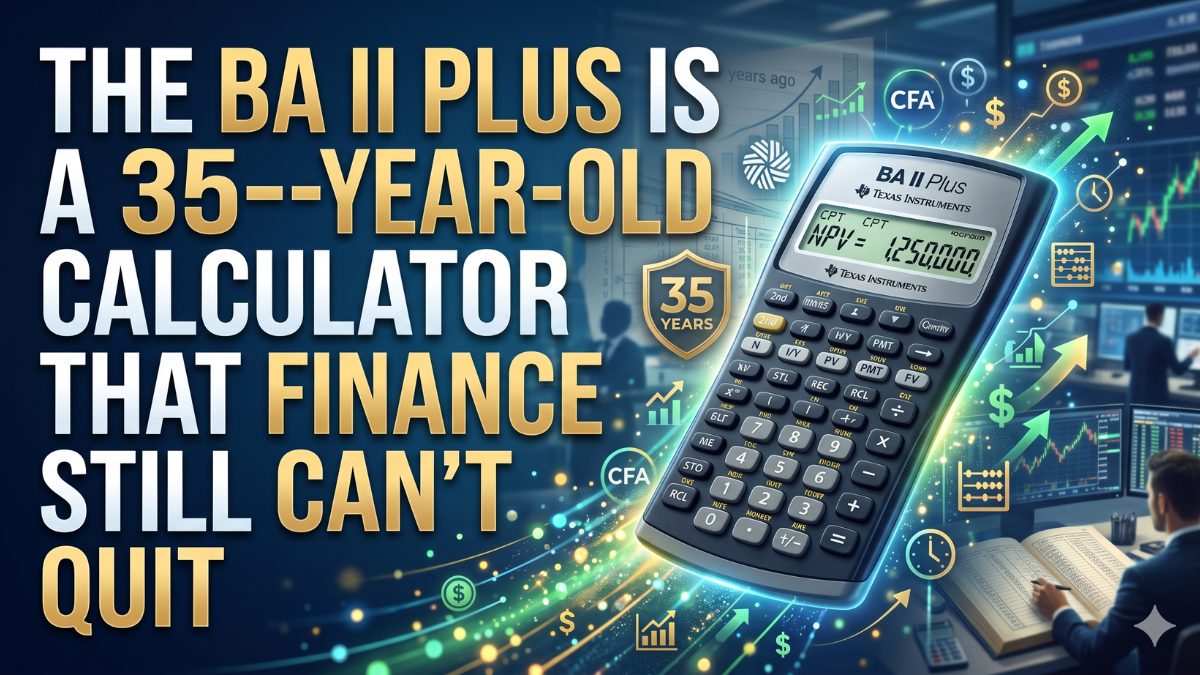
The Texas Instruments BA II Plus was introduced in 1991. The Soviet Union still existed. The internet wasn’t publicly accessible. A gallon of gas costs $1.14.
The calculator looks almost identical today.
That fact alone says something interesting about finance as a profession: the entire industry runs its most consequential exams on hardware designed when grunge was new. The CFA Institute permits exactly two calculator models for its exam: the TI BA II Plus and the HP 12C. That’s it. Two options. One of which was introduced in 1981. CFA Institute
There’s a version of this story where that’s embarrassing. There’s another version where it’s just correct.
Why does it still win
The BA II Plus handles time-value-of-money calculations, cash-flow analysis for up to 24 uneven cash flows, bond pricing, four depreciation methods, and list-based statistics with four regression options. It does all of that on a single-line LCD display with buttons that require deliberate effort to press. No touchscreen. No color. No Bluetooth. You can change the battery with a small screwdriver. Texas Instruments
The CFA Institute permits only the TI BA II Plus and HP 12C. The BA II Plus is the most popular choice due to its user-friendly interface. “User-friendly” is relative here. The thing requires you to memorize key sequences, like 2nd → CLR TVM before you can start a new calculation, and it defaults to 2 decimal places until you change it. To change that, you press 2nd → FORMAT, find DEC = 2.00, and enter 4 or 9 for floating-point decimals. Kaplan Schweser Kaplan Schweser
So not exactly intuitive. But compared to the competition? The HP 12C uses Reverse Polish Notation, where you enter operands before operators. The HP 12C was introduced in 1981, and little has changed in design or functionality since. It became the de facto standard at banks for years, handed to newcomers as a rite of passage. RPN is genuinely efficient once you’ve internalized it. It also takes days to learn when you’ve spent your entire academic life entering it 3 + 4 = in that order. 300 Hours
Most candidates aren’t fluent in RPN. The TI wins because standard algebraic entry is what people already know. Finance is hard enough. Nobody wants to debug their calculator logic the night before Level I. I Pass the CFA Exam
Basic vs. Professional: the real comparison
The BA II Plus Professional costs roughly twice as much and looks the part. Metal casing, heavier feel, no slide case included. It handles up to 32 uneven cash flows (vs. 24 on the basic), adds MIRR and NFV calculations, six depreciation methods instead of four, and payback/discounted payback period functions. Texas Instruments
Whether those extra functions justify the price depends entirely on which exam you’re taking and how far along you are.
Having tested both thoroughly, at least one experienced CFA candidate recommends the basic model. The button press is superior without much force required. The professional version, despite feeling more premium, has harder buttons and is nearly 50% heavier, including its cover. 300 Hours
The biggest weakness of both models is the same: you cannot press a key until you’ve completely released the previous key, or it won’t register. That’s a real problem under exam pressure. You’re 80 minutes in, running low on time, and your IRR calculation is wrong because your finger didn’t fully lift on the second keystroke. Amazon
The standard model also has no friction feet, so the calculator moves around as you type. The professional has two rubber bumps at the top and plastic at the bottom, which produces a slight rotation effect. For a product that’s been selling for 35 years, these feel like fixable oversights. Amazon
The exam constraint shapes everything
Here’s what makes the BA II Plus conversation different from most product discussions. Your calculator will be inspected before the start of the CFA exam and must remain on your desk in full view throughout. Proctor’s check. You can bring a backup (same approved models only), and you may keep a small screwdriver if you need to replace the battery. CFA InstituteCFA Institute
That last detail is very specific and very real. People have had batteries die mid-exam.
You have approximately 90 seconds per question on the CFA exam. The equations are complicated enough that passing without a calculator is essentially impossible. So the calculator isn’t a nice-to-have. Muscle memory with this specific device is part of the preparation. Kaplan Schweser
User tests show the professional version stores up to 40 cash-flow lines and calculates IRR on a 30-year bond in well under a second. Finance-first keys for NPV, IRR, bond price/yield, and amortization save 20-30 seconds per problem through dedicated worksheet menus. Over a 3-hour exam, those seconds add up. Pro School Online
The actual use case
The BA II Plus is approved for the CFA, FRM, and CMA exams. Most finance and accounting programs require or recommend it. It solves annuities, mortgages, leases, and depreciation schedules and lets you choose between actual/actual or 30/360 day-count methods for bond calculations. Texas Instruments
What it can’t do: graphing, symbolic computation, anything requiring more than a single-line display. You won’t use it to model a DCF in Excel style. That’s fine. The point isn’t versatility. The point is that when you need bond duration in a testing room with no internet, no spreadsheet, and 90 seconds on the clock, this device does it.
The critics are right that TI could update the build quality. Rubber feet on all four corners, better key registration, maybe a slightly deeper-set screen. These aren’t radical asks.
But the core product? The workflow, the worksheet structure, the algebraic input, and the exam approval? Nobody’s replacing it. Finance professionals bought it in 1995 and handed it to their kids, and those kids are now sitting for Level II.
Some tools earn that kind of loyalty by being excellent. The BA II Plus earned it by being indispensable.